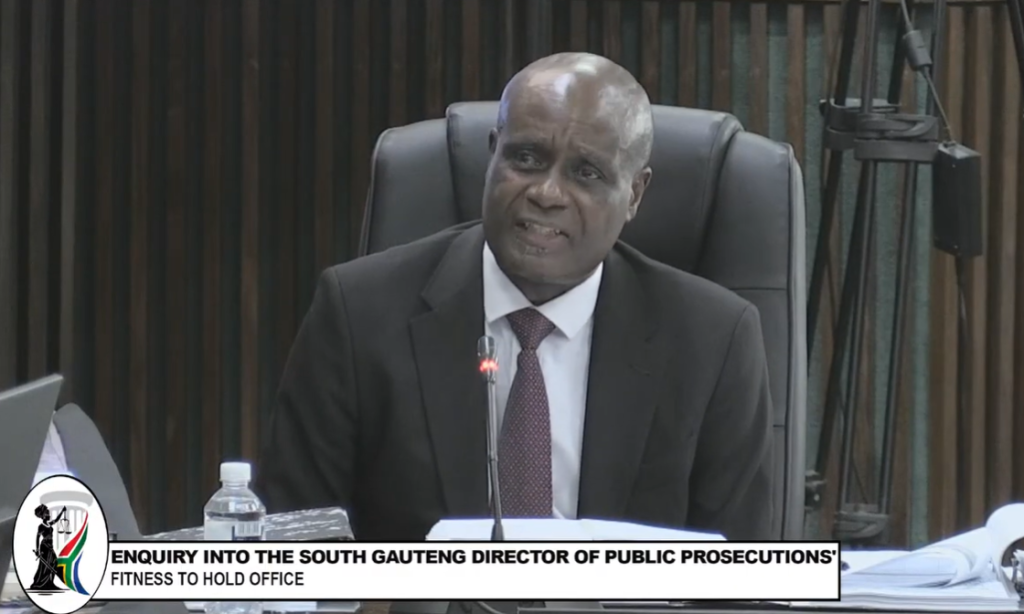
A panel chaired by Justice Bess Nkabinde (the “Panel”) has dismissed an application by the National Prosecuting Authority (NPA) to participate as a separate party in the enquiry into the fitness of Advocate Andrew Chauke to hold office as Director of Public Prosecutions for South Gauteng. The NPA, through an application, sought permission to present its own evidence and cross-examine witnesses through its own counsel. In dismissing the application, the Panel found the request to be speculative and inconsistent with the inquisitorial nature of the Enquiry, holding that the NPA’s interests are adequately represented by the Evidence Leaders.
Adv. Chauke, the suspended Director of Public Prosecutions for South Gauteng (“DPP”), is represented by the head of our Dispute Resolution practice, Mr Leslie Mkhabela, assisted by Mr Katleho Mohlokoane (Associate) with Advocates Tembeka Ngcukaitobi SC, Tshidiso Ramogale, Michaela Kritzinger, and Thembelihle Links as counsel.
The Enquiry was instituted following various allegations regarding Adv Chauke’s fitness and propriety to hold office as Director of Public Prosecutions and member of the prosecuting authority. After considering the allegations, President Cyril Ramaphosa suspended Adv. Chauke with effect from 20 July 2025 and established the Enquiry to assess Adv. Chauke’s fitness to remain in office as the DPP.
The Enquiry formally began proceedings on 17 November 2025.
On 12 February 2026, after the Enquiry had been underway for an extended period, the NPA applied to the Panel to allow it to participate in the Enquiry as a separate party from the Evidence Leaders and to be represented by its own counsel (the so-called “decoupling” from the Evidence Leaders).
In this application it also asked for permission to lead evidence that the Evidence Leaders might not present, to question witnesses including Adv. Chauke, and to make submissions directly to the Panel. Adv. Chauke opposed the application. The Evidence Leaders did not oppose the application.
A key feature of enquiries of this nature is that the chairperson is generally empowered to determine the rules and procedure that will govern the relevant enquiry.
In this instance, the rules of the Enquiry state that it must be conducted in an inquisitorial manner. This means that the Panel takes an active role in establishing the facts, with the assistance of Evidence Leaders who present the relevant evidence and are expected to assume a neutral and independent role in the Enquiry proceedings. The proceedings are therefore not intended to operate on an adversarial basis i.e., like a typical court case between opposing parties.
The NPA argued that the current rules do not allow its complaint to be properly presented. It further argued that since the Evidence Leaders ought to act independently and might decide not to call certain witnesses or ask certain questions, this placed the NPA in a position where an application of such nature was warranted.
The Panel held that the concerns raised by the NPA were speculative, and that the NPA failed to establish the facts necessary to sustain the application. The application was therefore based on what might happen in the future (in the Panel’s words, “anticipatory”) rather than on any actual problem that had already occurred.
The Panel also noted that the NPA’s role in the Enquiry is that of the complainant and not a prosecutor or adversarial party. The Evidence Leaders are responsible for presenting evidence to assist the Panel in establishing the facts, whether favourable to Adv. Chauke or unfavourable. Allowing the NPA to lead evidence separately and cross examine witnesses would negatively change the structure of the Enquiry and interfere with the role of the Evidence Leaders. The Panel viewed this consideration with such seriousness that it stated that were this to be the case, “the work of the Panel would be hamstrung”.
The Panel also rejected the NPA’s argument that it should have the same rights as Adv. Chauke’s legal team. The Panel found that Adv. Chauke is the subject of the Enquiry and may face serious consequences if the findings go against him. For that reason, his lawyers are allowed to cross-examine witnesses. The NPA is not in the same position.
Allowing the NPA to question witnesses separately would also prejudice Adv. Chauke because he would effectively face two sets of cross-examinations: one from the Evidence Leaders and another from the NPA’s lawyers. It would also delay the Enquiry and risk turning the proceedings into an adversarial process, which is not how the Enquiry is meant to operate.
The Panel found that the NPA’s interests are already sufficiently represented in the Enquiry by the Evidence Leaders. The NPAfailed to show that it had been prevented from providing information to the Evidence Leaders or that its complaint was not being properly placed before the Panel.
For these reasons, the Panel held that the NPA had no legal basis to participate in the Enquiry as a separate party, to lead its own evidence, or to cross-examine witnesses.
The application to decouple by the NPA was dismissed.
The decision by the Panel reaffirmed the principles that govern enquiries of this nature, highlighting that the independence of the Evidence Leaders as well as the inquisitorial nature of proceedings may not be tampered with unless a party is able to provide cogent reasons and evidence for such course of action.